


The restoration of classic boats and their designs, such as the Dolce Vita


Over the past two decades, a clear trend toward restoring tradition has emerged in recreational boating. The organization of numerous classic boat regattas, both in the Mediterranean and the Caribbean, shows that wood and varnish are making a comeback, evoking an era of distinguished designs, exclusivity, and nautical elegance. It is very likely that the saturation of the seas with fiberglass boats and repetitive, impersonal designs has led owners with a taste for distinction to seek that refined style from the past.
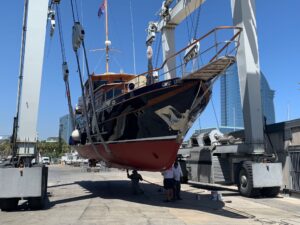
Teak, varnish, chrome, and brass take us back to an era of prestige and elegance that is difficult to achieve with the mass-produced constructions common today. The buying and selling of classic boats, both motor and sailing, is increasingly frequent, aiming to give them a second or third life thanks to the work of specialized shipyards: the “back in time” of these jewels.
In many cases, these projects involve giving up comforts and features that modern designs provide to their owners, such as those enormous aft platforms transformed into genuine “beach clubs,” or the huge windows or hatches that allow access to a swim directly from the owner’s cabin. But these sacrifices bring a rewarding payoff: the distinguished image of elegance that catches the eye of passersby in any port.
Recently, those of us who appreciate this type of boat have been able to enjoy the restoration of yachts steeped in history, such as the “Altair” (William Fife) of the legendary owner Miguel Sans and the “Orion” (Camper & Nicholson) of the Bertrand family. There are also more recent motor yacht projects, like the restorations of the “Shemara” (John Thornycroft & Company) of the distinctive Lady Docker or the “Marala”, long owned by the well-known shopping centre magnate Robert de Balkany, now recently returned to its original design lines at the prestigious Pendennis Shipyards.
The trend of looking to the past is so strong that today many shipyards, without abandoning modern construction materials, are turning on their design tables to recover lines from the early 20th century. Inverted bows in the style of old warships, as seen in the yacht “A” designed by Philippe Starck, are yet another example of this trend.
It is clear that the old and the classic dazzle and stand out over modern designs, which, though more functional and equipped with more features and comforts, tend to go unnoticed on the pontoons of marinas due to their volumes and dimensions.
In this context, in our shipyard we have had the pleasure of working on the “Dolce Vita.” It is a relatively recent build, from 2005, designed by Oliver Design, a prestigious naval engineering studio with a history including the elegant Revilo yachts from the late 1970s.
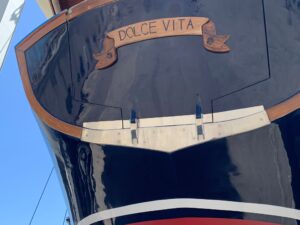
The “Dolce Vita” takes us back to an era of glamour, nautical prestige, and exclusivity. Wood on every surface, lavish varnish, and the craftsmanship of true shipwright masters, all without forgoing discreet modern gadgets such as hydraulic aft platforms, state-of-the-art stabilizers, and a few toys for the enjoyment of its owners or charter clients when needed.
Its 20-meter length makes it easily compatible with Mediterranean ports, especially those in the Balearic Islands, which are the waters this beautiful motor yacht frequents. Additionally, its modern 2×320 MAN engines provide a smooth navigation experience in line with its hull and style.
During its stay at Barcelona Nautic Center, we carried out maintenance and conservation tasks to keep it in impeccable condition and ready for the summer. Varnish touch-ups, inspection of the electrical system, engine tuning, hull cleaning and painting, and a thorough general inspection of the entire vessel were performed to ensure a trouble-free and fully enjoyable summer.
The case of “Dolce Vita” demonstrates that returning to the past does not necessarily require acquiring an antique boat. This elegant yacht was built in 2005 with a design inspired by the early 20th century, intentionally avoiding fiberglass and using fine wood instead. These approaches allow the recovery and preservation of crafts that are tending to disappear, such as the renowned mestres d’aixa, whose maritime masterpieces have fortunately been given a second life.
